

Table of Contents
Have you ever looked at a chemistry formula and thought, “What does that even mean?” You’re not alone! Let’s take a look at one that might look confusing at first — hcooch ch2 h2o. While it seems like a code, this formula actually tells an interesting story about chemical reactions and organic compounds. In this guide, we’re going to break it down, step by step. Don’t worry — we’ll keep everything light, clear, and super simple. Whether you’re a curious student, a teacher looking to explain something in a fun way, or someone just wanting to understand what this sequence of letters and numbers means, you’re in the right place. Chemistry doesn’t have to be scary or tricky. With the right approach, tough formulas like hcooch ch2 h2o suddenly make so much sense. So, let’s dive in and explore exactly what’s happening here — in a way that feels like a friendly chat, not a science textbook.
What Is HCOOCH CH2 H2O?
Let’s start at the beginning. The formula hcooch ch2 h2o is trying to describe a chemical compound and its breakdown. To better understand it, we can look at each part. HCOOCH stands for methyl formate, which is an organic compound made from formic acid and methanol. It’s often used as a solvent or starting material in chemistry. CH2 is a carbon-hydrogen group that appears in many organic molecules. Finally, H2O is just water — plain and simple. So, when it’s all put together like this, it often refers to a chemical reaction, possibly showing how methyl formate reacts or forms with water in the presence of certain conditions. Understanding each part makes the whole formula less scary. It’s just like solving a puzzle — one piece at a time.
Breaking Down the Formula Simpler
Chemistry loves to speak in codes, and hcooch ch2 h2o is a good example. So let’s unlock that code. The first part, HCOOCH, is made of carbon, hydrogen, and oxygen. It’s basically an ester — a compound made when an acid and alcohol react. That’s methyl formate. Then we have CH2 — this tells us there’s a part of a molecule with two hydrogen atoms attached to a single carbon. And finally, good old H2O — water. Some sources combine these chemical symbols to represent a reaction where methyl formate breaks down in water, or maybe water is part of its production. It really depends on the context. But don’t worry, you don’t need a lab coat to figure this out!
What Is Methyl Formate?
Methyl formate (HCOOCH3) is a colorless liquid with a fruity smell. It naturally occurs in some fruits and is used in flavorings, perfumes, and manufacturing. It’s also one of the simplest esters you’ll find in organic chemistry. In industries, methyl formate is used in the making of formic acid. Some companies also use it as a blowing agent for foam. While it smells sweet, it should never be tasted or inhaled deeply — it’s still a chemical. Methyl formate is flammable and evaporates quickly, which makes it useful in certain reactions. Learning about methyl formate helps us understand what the HCOOCH part of hcooch ch2 h2o really stands for.
What Happens When HCOOCH Meets Water?
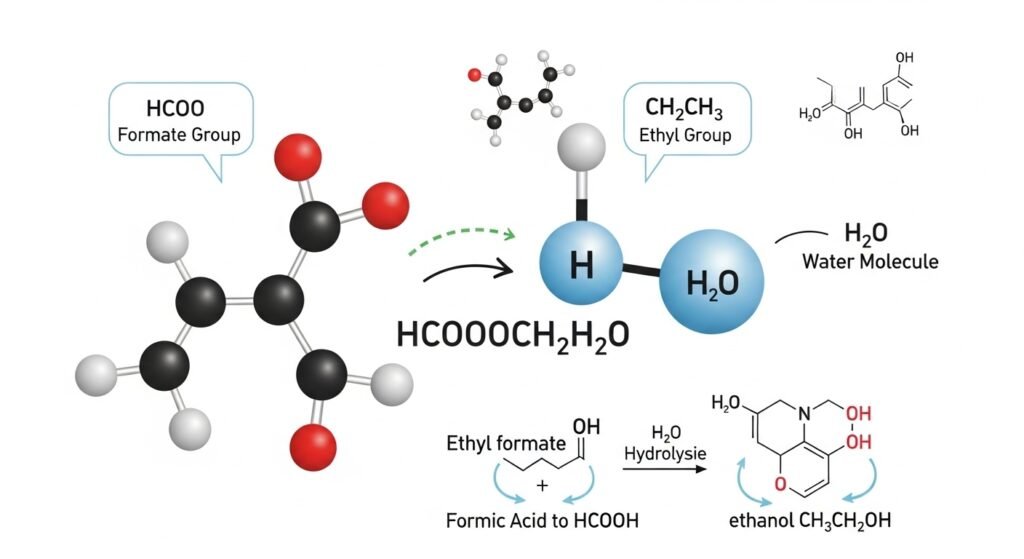
When methyl formate (HCOOCH) mixes with water (H2O), something interesting can happen — a hydrolysis reaction. Hydrolysis means that water breaks a molecule apart. Here, the ester bond in HCOOCH can be broken down into more basic parts: methanol and formic acid. Chemically, it looks like this:
HCOOCH3 + H2O → HCOOH + CH3OH
This means methyl formate and water combine, and the result is formic acid (HCOOH) and methanol (CH3OH). It’s like water comes in and cuts the molecule in half. This reaction is important in both chemistry labs and industries because it helps change esters into two useful products. Now that’s some water-powered magic!
Where Does CH2 Fit In?
CH2 is short for a methylene group. It’s a piece of a molecule that contains one carbon and two hydrogen atoms. It’s like a building block inside many bigger molecules. If you see CH2 near HCOOCH or H2O, it might be part of a larger ester or acid. Or it might be just showing the structure of the molecule during a reaction. In some explanations of the formula hcooch ch2 h2o, CH2 may be referring to a molecule that includes this methylene group in a chain. This shows how chemists write molecules in parts to make their structures easier to understand. Even though CH2 seems small, it plays a big part in shaping and fueling organic reactions.
Real-Life Use of Methyl Formate and Its Reaction Products
You might be surprised where hcooch ch2 h2o can indirectly pop up in real life. The chemicals involved — methyl formate and its breakdown products (like methanol and formic acid) — are actually all around us. Methyl formate is used in things like perfumes, insecticides, solvents, and even flavor compounds. Methanol is a type of alcohol used in fuels, antifreeze, and even processed into formaldehyde. Formic acid is used in leather-making and food processing. These compounds sound complex, but they’re super useful. Understanding their reactions — like hydrolysis with water — helps factories work safely and efficiently. That tiny formula hides some big practical power!
What’s an Ester, Anyway?
Since methyl formate is an ester, let’s take a second to understand what esters are. An ester is a chemical compound made when an acid reacts with an alcohol. These reactions are often helped along by heat or a catalyst like an acid. Esters smell great — many fruity and floral perfumes come from esters. That’s why they’re used so much in food flavoring and cosmetics. The formula for esters is usually something like R-COO-R’, where R and R’ are carbon chains. In HCOOCH, the “HCOO” part comes from formic acid, and the “CH” is from methanol (alcohol). When water joins the reaction, the ester can break apart again, giving you back the alcohol and acid. It’s like reversible chemistry magic!
Understanding Hydrolysis in Plain English
Hydrolysis might sound like a giant science word, but it’s actually a very common idea. It simply means using water to break something apart. In the case of hcooch ch2 h2o, it means water helps split methyl formate into simpler parts. Think of it like water acting like scissors. It cuts the chemical into smaller, more useful pieces. If you’ve ever soaked dried fruit in water to make it softer, you’ve seen hydrolysis in action in cooking form. In chemistry, it happens inside test tubes, machines, or even our own bodies. Enzymes in your stomach use hydrolysis to break down food every day. It’s all the same beautiful science!
Safety Notes on HCOOCH and Methanol
While the chemistry is cool, it’s important to know that hcooch ch2 h2o isn’t just a homework question — it’s tied to real chemicals, and some of them can be risky. Methyl formate is flammable and can irritate the skin or eyes. Methanol, one of its reaction products, is even more dangerous if handled the wrong way. Never drink, inhale, or touch it without protection. Methanol can be toxic and even deadly in large amounts. Chemists wear gloves, goggles, and often work in ventilated labs when using these chemicals. So, if you’re experimenting with anything like hcooch ch2 h2o, always follow safety guidelines or ask an adult or teacher for help.
What Makes This Chemistry Helpful?
You might wonder, “Why should I care about hcooch ch2 h2o?” The answer is — because it helps make everyday things better! Many processes in food, cleaning, fuel, and medicine are based on these kinds of reactions. Chemists use them to create safe perfumes, better plastics, and powerful medicines. Engineers work with these reactions to make cars run cleaner and make packaging safer. Even farmers use chemicals involving formic acid and methanol for storing animal feed. Understanding what happens with hcooch ch2 h2o gives you a tiny peek into the world of useful reactions making our lives easier.
How Scientists Discover and Use Chemical Reactions
It’s one thing to know a chemical reaction — but how do scientists figure it out? They start by trying different mixes of chemicals and observing the results. With something like hcooch ch2 h2o, they would measure what happens when methyl formate is mixed with water under different temperatures or conditions. They use tools like pH meters, gas detectors, and spectrometers to study everything. Once they understand the full reaction, they test it again and again for safety and consistency. Only after deep testing do reactions reach industries. It takes teamwork between scientists, engineers, and quality control experts. It’s not magic — it’s mindful experimenting.
Chemical Equations vs Real World Action
Here’s something cool. A formula, like hcooch ch2 h2o, is just a symbol. On paper, it looks simple. But in real life, it’s a process with tools, equipment, heat, time, and possibly smell or color change. A written formula is like a recipe — it’s not the same as cooking, but it tells you what goes in and what should come out. When a chemist sees HCOOCH and H2O together, they don’t just say, “Ah, methyl formate plus water!” — they imagine reactions, setup, safety checks, and possible uses afterward. So the symbol is only step one in a much bigger journey.
FAQs
1. What does hcooch ch2 h2o mean in chemistry?
It refers to a reaction or structure involving methyl formate (HCOOCH), a CH2 group, and water (H2O), usually part of a hydrolysis reaction.
2. Is HCOOCH the same as methyl formate?
Yes! HCOOCH is the short form describing methyl formate, an ester made from formic acid and methanol.
3. What happens when methyl formate reacts with water?
It breaks down into formic acid and methanol. This is called hydrolysis, and it’s common in ester chemistry.
4. Is methyl formate safe to use?
Only in controlled settings. It can be flammable and irritating. Always follow proper lab and safety rules when handling it.
5. Why is water important in chemical reactions?
Water is often used to create or break molecules. In hydrolysis, water helps split esters into simpler substances.
6. Can these reactions happen in nature?
Yes! Similar ester hydrolysis reactions happen naturally in plants, animals, and even inside your body every day.
Conclusion
So, now you know — hcooch ch2 h2o isn’t just a random set of letters and numbers. It opens the door to understanding how organic molecules like esters behave, how they react with water, and why that matters in real life. From perfumes and cleaners to fuels and flavors, this chemistry is all around us. We’ve looked at each part, from methyl formate to water reactions, and made it simple and clear. Learning about these kinds of formulas helps us appreciate the tiny-yet-mighty world of molecules. Next time you see a complex-looking formula, you’ll know how to break it down — and even explain it to someone else. Keep exploring, stay curious, and maybe, just maybe, your next science class will feel a little more exciting. If you found this guide useful, feel free to share it or leave a comment talking about your favorite fun chemistry fact! Keep learning — because science is awesome when it’s simple.